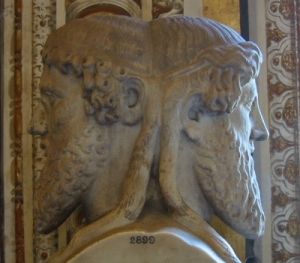
Bust of Janus – Vatican Museum, Vatican City
The Roman god Janus stands at the doorway of time, looking back at the Old Year with one of his faces and looking forward to the New Year with the other. He lends his name to the month of January, because the turn of the year is a significant, almost mystical moment. Once you have stepped through that doorway, you are not the same person, and who knows what you will now become? January 1 was the moment to make New Year’s resolutions and begin to create that new, different person—
Except that even by mid-January, and certainly later, two things seem to have become clear. First, everyone who made a New Year’s resolution has already broken it and failed miserably to change anything. And second, it’s a universally bad idea to make these resolutions in the first place. Once a person fails, he or she is likely to be discouraged from making any other future changes. As we walk through that doorway, we should kick Janus in the shins for the very idea of New Year’s resolutions. Shouldn’t we?
The problem is that both of these assumptions are at least partly false. Somewhere I sense Janus casting us a bit of a knowing look.
Why do people have this impulse to make a life change starting on a significant date? I suspect New Year’s resolutions reflect a psychological need for rites of passage. Those are the rituals—whether religious. like one’s first communion, or secular, like a graduation ceremony—that help people transition from one state of being to another. While still the same people, psychologically they have somehow stepped out of one phase of their existence (“I’m a student”) and into a different one (“I’m a graduate who is no longer in school”). It’s not that a student doesn’t know she’s no longer in school unless she has the ceremony; it’s more that a border has been established in her consciousness between “then” and “now.” It’s been marked and made official in some way.
Many psychologists speculate that one reason people feel rootless in the modern world and somehow have to “find themselves” is a lack of rites of passage. In older traditional societies, people used to fit more obviously into fixed slots, and they experienced more clear phases of life. But now it’s less easy for people to know where they really stand. Surprisingly, with so many choices available in today’s world, people still often feel like nothing is firmly in their grasp and that most things are out of their control. So they create significant moments when they can either ground themselves in one thing or can move from one state of being to another. Thus the resolutions pour forth: I’m going to lose thirty pounds; I’m going to socialize more; I’m going to read fifty books this year; I’m going to quit smoking; I’m going to take a trip to Japan.
But alas, despite the psychological need for significant transitions and changes, New Year’s resolutions just don’t work. The need might be there, but those resolutions don’t do the job.
Well…not so fast, there. Janus has begun to look positively smug. And wait till you see why.
Dr. Mike Evans (co-founder of Reframe Health Lab and now with Apple; formerly of St. Michael’s Hospital in Toronto, the University of Toronto, and the Li Ka Shing Knowledge Institute) has created a fascinating five-minute video specifically addressing New Year’s resolutions and offering some very encouraging statistics. These are based on studies of resolution-making by Dr. John Norcross (of the University of Scranton and SUNY Upstate Medical College). The bottom line is that you are probably ten times more likely to succeed if you plan your life changes to start at New Year’s than if you try to make those changes at any other time of year.
Dr. Norcross’s studies showed that people who planned significant life changes at times other than at New Year’s had a 51% success rate after two weeks, but their continuation rate dropped drastically to 4% after six months. Yet people who planned their changes for New Year’s had a stunning 75% success rate after two weeks. And even though this rate also dropped by the six-month mark, it still sat at 46%.
Did you see that? A forty-six percent success rate if you try to change at New Year’s, and four percent if you try at other times!
This sets New Year’s resolutions in a whole new light, doesn’t it? Dr. Evans thinks that New Year’s, despite the hoopla, creates a chance for people to be mindful and reflective. Those who succeed in their changes are likely to have planned them carefully and gradually. And there’s also a bit of a community aspect to New Year’s resolutions, because people usually go public with their planned changes, and others are more likely to give these people support and view them in the desired new light. So let’s see: an individual setting a point at which to pass from one state to another; a community to recognize and support this change in state. Why…this is beginning to sound suspiciously like a…
Maybe, after all, there is really something to this idea of New Year’s resolutions fulfilling the psychological need for a rite of passage. And Janus, standing at the boundary between the old state of being and the new, gets the last laugh.
[A similar version of this article was previously published in February/March 2014 in the now defunct Zen Dixie magazine]




 I remember when the evangelical church began railing against Jesus Rock music; anti-rock prophets assured everyone that rock rhythms altered people’s brains so much that they became literally incapable of choosing good over evil. The idea that music can remove free will is, of course, ridiculous—yet there’s no question it can influence our moods. In the past, sometimes the best cure for my gloomy mood was to play the anthemic “Never Give Up” by Boulevard, followed by “Don’t Worry, Be Happy” by Bobby McFerrin.
 Confessions of a Cultural Idiot